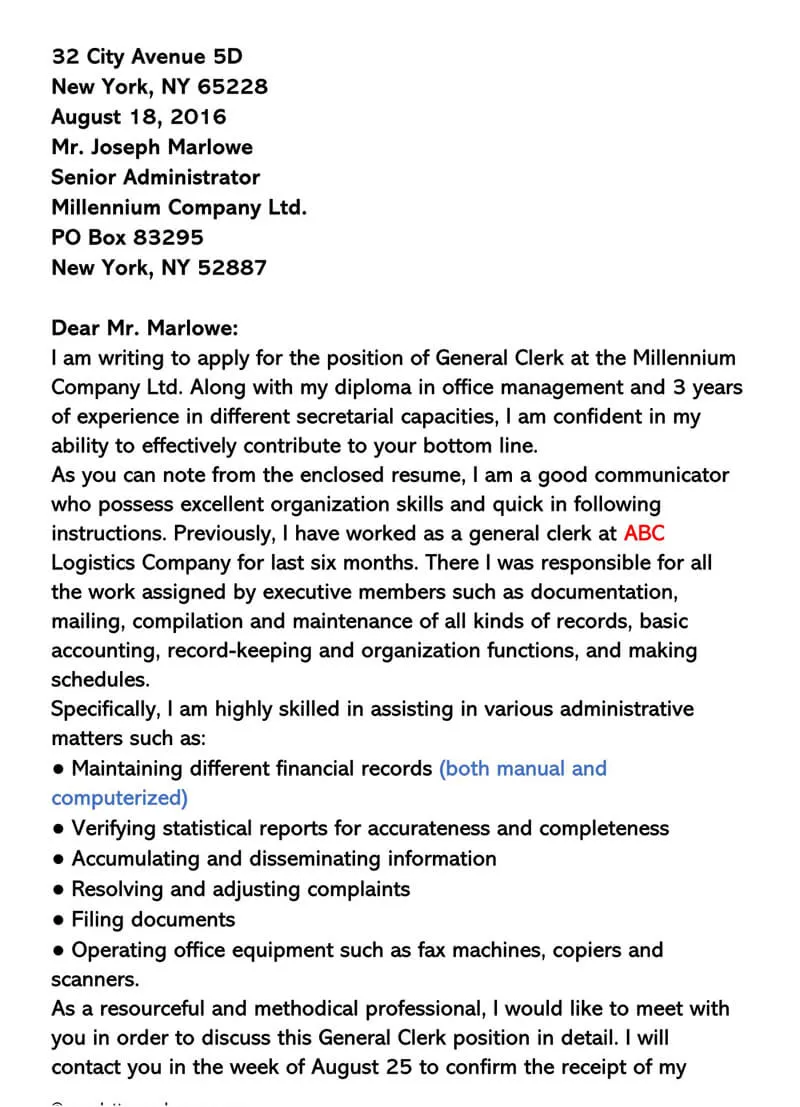
Understanding the Clerical Cover Letter
A clerical cover letter serves as your initial introduction to a potential employer, often accompanying your resume. It is a critical document that allows you to showcase your skills, experience, and enthusiasm for a clerical position. Unlike a resume, which provides a factual overview of your background, a cover letter allows you to express your personality, highlight your key accomplishments, and explain why you are the ideal candidate. It’s your chance to make a strong first impression and persuade the hiring manager to delve deeper into your qualifications. Understanding the importance of a well-crafted cover letter is the first step toward securing your desired clerical role. It’s not just about listing your past jobs; it’s about telling your story and demonstrating how your skills align with the specific needs of the employer.
Why a Strong Cover Letter Matters for Clerical Roles
In the competitive job market, particularly for clerical positions, a strong cover letter can be the deciding factor in whether you get an interview. Clerical roles often involve similar skill sets, such as data entry, organization, and communication. A well-written cover letter gives you the opportunity to differentiate yourself from other applicants by emphasizing how your unique experiences and abilities align with the specific requirements of the job. It provides a platform to highlight your soft skills, such as attention to detail, problem-solving, and time management, which are crucial for success in clerical jobs. Furthermore, a tailored cover letter demonstrates your genuine interest in the position and the company, showing that you’ve taken the time to research and understand their needs. This personalized approach significantly increases your chances of getting noticed by the hiring manager, showcasing that you are not just sending a generic application, but that you are truly interested in the role.
Essential Elements of a Winning Clerical Cover Letter

A winning clerical cover letter consists of several key elements that work together to present you as a strong candidate. These elements include a well-formatted header, a compelling opening, a detailed body highlighting your relevant skills and experience, and a confident closing. Each section plays a vital role in conveying your qualifications and making a positive impression on the reader. A strong header ensures your contact information is easily accessible, while the opening grabs the reader’s attention and clearly states your purpose. The body of the letter is where you showcase your skills, experience, and achievements, using specific examples to support your claims. Finally, the closing summarizes your interest in the position and encourages the employer to contact you for an interview. By incorporating all these elements and tailoring them to each specific job application, you’ll significantly increase your chances of success.
Header Section Contact Information
The header of your cover letter is the first thing an employer will see, so it needs to be professional and easy to read. Include your full name, address, phone number, and professional email address. Ensure that your email address sounds professional. For example, use your full name or initials rather than a casual nickname. Make sure your contact information is accurate and up-to-date. Place the header at the top left or center of the page. This information is crucial for the hiring manager to contact you for an interview if they are interested in your application. Proper formatting, such as using a clear font and consistent spacing, enhances the overall professionalism of your cover letter and shows attention to detail, a highly valued skill in clerical roles. The header helps establish a positive first impression.
Date
Following your contact information, the date is an essential element in your cover letter header. Write the date you are sending your cover letter. Place the date directly below your contact information, aligned to the left or the right, depending on your chosen style. The date serves to document when your application was submitted, which can be important for tracking your application status. Using the proper date format ensures your cover letter looks professional and polished. Ensure you are using the correct date, as errors can reflect a lack of attention to detail, a quality crucial in clerical positions where accuracy is essential. Double-check the date before submitting your application to avoid potential misunderstandings.
Recipient’s Details

After the date, you need to include the recipient’s details. This typically includes the name of the hiring manager (if known), their title, the company name, and the company’s address. Address the letter to a specific person whenever possible. If you cannot find the hiring manager’s name, use a professional greeting like “Dear Hiring Manager” instead of a generic salutation. Proper formatting is essential, ensuring the recipient’s information is clearly organized and easy to read. This level of detail and personalization demonstrates that you have taken the time to research the company and the specific role, highlighting your interest in the position. If the company name and address are slightly incorrect, it can reflect poorly on your attention to detail. The recipient’s details are critical in establishing a professional tone from the very beginning of your cover letter.
Opening the Cover Letter Making a Strong First Impression
The opening of your cover letter is critical for capturing the hiring manager’s attention and setting the tone for the rest of your application. A strong opening should clearly state the purpose of your letter — to express your interest in the clerical position — and immediately highlight why you are a suitable candidate. Avoid generic openings. Instead, personalize your introduction by mentioning where you saw the job posting or why you are particularly interested in the company. In addition to stating your purpose, the opening should briefly showcase your relevant skills or experiences. This helps to make your initial impression quickly and effectively. The goal is to grab the reader’s attention and encourage them to read on. A well-crafted opening can significantly increase your chances of getting noticed and making a positive first impression.
Crafting a Compelling Introduction
A compelling introduction should be concise and engaging. Start with a clear statement of your intent, such as “I am writing to express my keen interest in the Clerical Assistant position advertised on [Platform].” Follow this with a brief statement highlighting your most relevant skill or experience. For example, if the job requires strong organizational skills, you could mention, “With five years of experience in office administration and a proven track record of maintaining organized filing systems.” Avoid generic phrases such as “I am writing to apply for the position.” Instead, show enthusiasm and a genuine interest in the role and the company. Tailor your introduction to the specific job description and company culture. Research the company and use the introduction to show that you have a good understanding of their needs and how you can contribute to their goals. Be confident but professional, and make sure your enthusiasm shines through.
Highlighting Your Skills and Experience

The body of your cover letter is where you provide the details that support your claims in the introduction. This is the section where you highlight your key skills, experience, and achievements. Focus on the skills and experience that are most relevant to the clerical position you are applying for. Use specific examples to illustrate your abilities. Instead of merely stating “proficient in Microsoft Office,” you should write, “Proficient in Microsoft Office Suite, including Word, Excel, and PowerPoint, with demonstrated ability to create reports, manage spreadsheets, and develop presentations.” The goal is to provide concrete evidence of your skills and experience. Use action verbs to describe your accomplishments, and quantify your achievements whenever possible to make your impact more tangible. The best cover letters provide a balanced view of your technical skills and your soft skills, such as communication, teamwork, and problem-solving. You should provide enough detail to show you understand the role’s expectations and have a strong ability to perform them.
Showcasing Relevant Clerical Skills
When showcasing your skills, focus on those that are most important for a clerical position. Key skills include data entry, typing speed, organizational skills, attention to detail, proficiency in Microsoft Office (Word, Excel, Outlook), communication skills, and time management. Provide examples to back up your claims. For instance, if you list “strong organizational skills,” explain how you managed a complex filing system or organized a large project. Include examples where you applied your skills to achieve specific results. You should also address the needs of the employer, using the job description to identify the skills and qualifications they are seeking. Tailor your cover letter to show that you understand the requirements of the role and that you have the skills and experience to meet those requirements. Make sure to quantify your accomplishments whenever possible to prove your skills are strong.
Demonstrating Experience
Your experience section should give specific examples of your past roles and accomplishments. For each position, include the job title, the company name, the dates of employment, and a brief description of your responsibilities and achievements. Focus on experiences that are relevant to the clerical position you are applying for. Quantify your achievements whenever possible to demonstrate your impact. For example, instead of saying “Managed customer inquiries,” you could say “Managed an average of 50 customer inquiries per day, resolving issues efficiently and maintaining a 95% satisfaction rate.” Use action verbs to describe your roles and responsibilities, such as “managed,” “organized,” “processed,” “coordinated,” and “maintained.” This will show a hiring manager exactly what you did. When you have a lot of experiences, be concise, and select the most important experience in your cover letter, to avoid overwhelming the reader.
Quantifying Achievements

Quantifying your achievements is a very effective way to demonstrate the impact of your skills and experience. Instead of just stating that you “improved efficiency,” provide a quantifiable metric, such as “improved office efficiency by 15% within six months by implementing a new filing system.” This approach makes your accomplishments more concrete and easier for the employer to understand. Use numbers and percentages to illustrate your success. For example, you could state that you “reduced data entry errors by 20%” or “increased customer satisfaction by 10%.” When possible, use statistics to highlight your achievements. This will make your achievements much more convincing and memorable. When you quantify your achievements, be sure your numbers are accurate and verifiable. Quantifying is a key part of showing employers the value of your experience.
Tailoring Your Cover Letter to the Job Description
Tailoring your cover letter to the specific job description is essential for showing that you are a suitable candidate. Review the job description carefully and identify the key skills, qualifications, and responsibilities. Use the information to customize your cover letter, highlighting how your skills and experience align with the employer’s needs. Use the keywords from the job description in your cover letter. This will show that you have read the job posting and understand the requirements of the position. Provide specific examples of how you have demonstrated the required skills and experience in the past. Refer directly to the job description’s requirements when discussing your qualifications. For example, instead of just saying “I am organized,” mention “As required by the job posting, I have strong organizational skills developed while managing inventory systems for the previous company.”
Matching Keywords
When tailoring your cover letter, matching the keywords used in the job description is critical. Employers often use Applicant Tracking Systems (ATS) to scan resumes and cover letters for relevant keywords. By including these keywords in your cover letter, you increase your chances of being selected for the next round of hiring. Identify the key skills, qualifications, and responsibilities listed in the job description, and incorporate those terms into your cover letter. Use the same terminology and phrasing used in the job description. However, do not overstuff your cover letter with keywords. The letter should still read naturally. Keywords should be incorporated into your sentences to flow seamlessly and effectively showcase your qualifications. The best cover letters are customized so your keywords fit perfectly and help showcase your best abilities.
Addressing the Employer’s Needs

Demonstrate that you understand the employer’s needs by tailoring your cover letter to address their specific requirements. Research the company and the role to understand their goals, values, and challenges. Use the information you gather to highlight how your skills and experience can help the employer achieve their objectives. Identify the specific needs of the company. Then, explain how your skills and experience address those needs. Provide examples of how you have successfully solved similar problems or met similar challenges in the past. Show a genuine interest in the company and their mission. Discuss the reasons why you want to work for this particular company, highlighting their positive qualities and values. When your cover letter clearly explains what you understand about the employer’s needs, it will make you stand out to the hiring manager.
Writing a Strong Closing
Your closing paragraph should leave a positive final impression and encourage the employer to take the next step. It is where you summarize your interest in the position and reiterate your enthusiasm. Thank the employer for their time and consideration. Reiterate your key qualifications. Express your desire for an interview. Include a call to action, such as “I look forward to the opportunity to discuss my qualifications further” or “I am available for an interview at your earliest convenience.” Proofread your closing carefully to ensure it is free from errors. Your closing should be confident, professional, and tailored to the specific job and company. The closing is your final chance to leave a strong impression and encourage the employer to contact you.
Expressing Enthusiasm and Interest
Expressing enthusiasm and interest in the position and the company can significantly increase your chances of making a positive impression. Show that you are genuinely excited about the opportunity. Mention why you are interested in the specific role and the company, highlighting their values, mission, or accomplishments. Avoid generic statements. Instead, explain what specifically attracts you to the role and the organization. Show that you have researched the company and understand their work. Demonstrate that you have a strong interest in the company’s work. Being enthusiastic will demonstrate that you are not just looking for a job but are truly interested in the company’s goals and how you can contribute to those goals. The hiring manager will want to work with people that are genuinely interested, so this will help you succeed.
Call to Action

A call to action is an essential component of your closing paragraph. It tells the employer what you want them to do next. Be clear and direct about your desire to be contacted for an interview. Include specific instructions for the hiring manager to follow up, such as mentioning your availability for an interview. If there is a particular method for contacting you, include it in the closing. Be proactive and express your willingness to provide additional information or answer any questions they may have. Make it easy for the employer to take the next step. For example, “I am available for an interview at your earliest convenience and can be reached by phone at [phone number] or by email at [email address].” A strong call to action can substantially increase the chances of your getting an interview.
Proofreading and Formatting
Proofreading and formatting your cover letter are crucial steps in ensuring your application makes a professional impression. A cover letter with errors, or poorly formatted, will reflect poorly on your attention to detail and may lead the employer to assume that you are careless or unprofessional. Proofread your cover letter carefully for any spelling, grammatical, or punctuation errors. Use a spell-checker and grammar-checker, but don’t rely on them completely. Read your cover letter multiple times, and consider having a friend or family member review it. Ensure the formatting is clear, consistent, and easy to read. Use a professional font (such as Times New Roman or Arial), and keep the font size between 10 and 12 points. Use clear spacing between paragraphs, and make sure the margins are consistent. Use a professional tone and language throughout your cover letter. This will make it easier to understand and more appealing to the hiring manager. It can show you will be organized in your work too.
Ensuring Error-Free Content
Ensuring your cover letter is free of errors is essential for making a positive impression. Spelling mistakes, grammatical errors, and typos can significantly detract from your credibility and indicate a lack of attention to detail. Use spell-check and grammar-check tools. But don’t rely solely on these tools. Proofread your cover letter multiple times. Read it aloud to catch any awkward phrasing or errors. Ask a trusted friend or family member to review your letter for any mistakes you might have missed. Pay special attention to the names of the hiring manager, company name, and any specific details mentioned in the job description. Double-check dates, contact information, and other important details to avoid making any costly mistakes. You should also ensure your sentences flow logically. Any errors can signal to the employer that you don’t pay attention to detail, which is critical for clerical work.
Formatting Tips
Proper formatting can make your cover letter more readable and professional. Use a clean and professional font such as Times New Roman, Arial, or Calibri. Keep the font size between 10 and 12 points. Use standard margins (1 inch on all sides) for a balanced look. Use single-space within paragraphs and double-space between paragraphs to create visual separation. Use a clear and consistent format throughout your cover letter. The header should include your contact information and the date. Ensure the date is formatted correctly. Use the correct salutations (e.g., Dear Mr. / Ms. Last Name). Ensure proper spacing, and use bullet points to highlight your skills and accomplishments. Avoid using excessive bolding, underlining, or italics, as this can be distracting. The formatting shows the employer your organizational skills, so proper formatting will make your cover letter look professional.
Clerical Cover Letter Samples & Examples
Reviewing clerical cover letter samples and examples can provide valuable guidance when crafting your own cover letter. These samples can help you understand how to structure your letter, highlight your skills, and tailor your content to specific job descriptions. Use cover letter samples as a starting point and adapt them to reflect your unique skills, experience, and the specific requirements of the job you are applying for. Pay attention to the language used in the samples and how the authors highlight their accomplishments and qualifications. Tailor your cover letter to match the tone and style of the job description. This shows the hiring manager that you took the time to find out about the company and what they need. Examples and samples will help you get the tone right and get you hired.
Sample Cover Letter 1 Entry-Level
Here is an example of an entry-level clerical cover letter. In the entry-level cover letter, you can emphasize your education and any relevant coursework or projects. If you have any internships or volunteer experience in an office environment, highlight those. Showcase your soft skills such as attention to detail, communication, and problem-solving. Clearly state your career goals and how the position aligns with your aspirations. Customize this sample by adding your details, and be sure to modify the skills mentioned according to the specific job description. Be sure to maintain a professional tone and focus on showing how your skills and experiences align with the employer’s requirements. Make it stand out by tailoring the information to match your own experiences. Customize your letter and ensure it is well-written, with no errors, to make the best possible impression.
Sample Cover Letter 2 Experienced Professional
Here is an example of an experienced professional clerical cover letter. Highlight your years of experience in clerical roles, and focus on your specific skills and accomplishments. Quantify your achievements whenever possible. Provide concrete examples of how you improved efficiency, reduced costs, or enhanced customer satisfaction. Use action verbs to describe your responsibilities and accomplishments. Tailor your cover letter to the specific job description. Showcase your expertise in key clerical skills, such as data entry, organization, and office management. Customize this sample by replacing the details with your own. Always make sure that the tone is professional and confident. Ensure that the cover letter is free from errors and reflects your skills. If you are looking for a new job, this can help you make the best impression and move on to the interview process.
Key Takeaways & Final Tips
Crafting an effective clerical cover letter requires careful attention to detail, tailoring your message to the specific job, and highlighting your skills and accomplishments. Remember, the cover letter is your first impression. Be sure to conduct thorough research on the company, the specific role, and the hiring manager. Focus on showcasing how your skills and experience align with the requirements of the job. Provide specific examples to support your claims and quantify your achievements whenever possible. Proofread your cover letter carefully for any errors in spelling, grammar, or formatting. A well-crafted cover letter increases your chances of getting an interview and ultimately landing your desired clerical position. When you follow these guidelines, you are much more likely to be chosen.